
Selling into Indonesia & SEA: platform guide

Updated: Jul 28
To sell into Indonesia and SEA, foreign brands use Shopee (the regional leader), Lazada (with cross-border LazGlobal), Tokopedia (needs a local entity), and fast-rising TikTok Shop — with localized listings, local payments and logistics per market.
Key takeaways
Shopee leads SEA (industry estimates ~half of regional GMV in 2024).
Lazada's LazGlobal enables cross-border selling.
Tokopedia needs a local entity/distributor.
TikTok Shop is rising fast across the region.
About shopfever: a one-stop cross-border e-commerce partner and official Tmall Global distributor — import, warehousing, store operations, logistics, KOL marketing and data — helping global brands sell into China and Asia.
SEA's platform landscape
Southeast Asia's e-commerce is led by Shopee, Lazada, Tokopedia and the fast-rising TikTok Shop, plus Amazon in some markets. Shopee is the clear regional leader, with industry estimates putting it at roughly half of regional GMV in 2024 (figures vary by source). The region is diverse — markets like Indonesia, Thailand, Vietnam, Malaysia and the Philippines each have their own leaders and consumer habits.
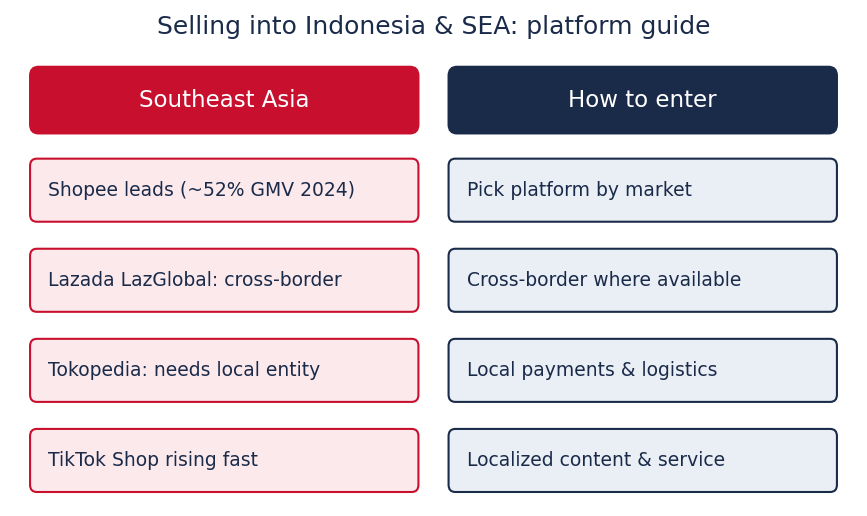
Fig. 1: Selling into Indonesia & SEA
Entry routes for foreign brands
Shopee: largest reach; strong for everyday categories.
Lazada: LazGlobal cross-border program for foreign sellers.
Tokopedia: no cross-border program — needs local entity/distributor.
TikTok Shop: content-led commerce, growing rapidly.
How to enter
Pick platforms by target market, use cross-border programs (e.g. LazGlobal) where available, and ensure local payments and logistics. Localized listings, competitive pricing and responsive service matter as much as platform choice. A regional partner can manage multiple marketplaces and local fulfilment.
Per-market notes
SEA is not one market: Indonesia is huge and Shopee/Tokopedia-led, Thailand and Vietnam are Shopee/Lazada strongholds, and TikTok Shop is reshaping the region. Prioritise one or two markets, use cross-border where available, and localize payments, logistics and language for each.
Prioritise one or two markets first
Use cross-border (LazGlobal) where available
Localize payments and logistics per market
Watch TikTok Shop's rapid growth
Bottom line
Southeast Asia is a fast-growing but fragmented region. Shopee leads, Lazada offers cross-border via LazGlobal, Tokopedia needs a local entity, and TikTok Shop is surging. Choose platforms by market, use cross-border programs where available, and localize payments, logistics and service — ideally with a partner managing multiple marketplaces.
FAQ
Which platform is biggest in SEA?
Shopee is the regional leader (industry estimates ~half of GMV in 2024); Lazada and TikTok Shop are major players too.
Can we sell cross-border?
Yes on Lazada (LazGlobal) and via TikTok Shop; Tokopedia generally needs a local entity.
What's essential to win?
Localized listings, local payments and logistics, and responsive service per market.
Want to expand across Southeast Asia? shopfever runs multi-marketplace selling — Shopee, Lazada, TikTok Shop — with local fulfilment. Talk to us. |
Market-by-market notes
Southeast Asia is not one market. Indonesia is huge and led by Shopee and Tokopedia; Thailand and Vietnam are Shopee/Lazada strongholds; the Philippines skews to Shopee; and TikTok Shop is reshaping discovery across the region. Prioritise one or two markets first rather than launching everywhere, and tailor assortment and pricing to each.
Indonesia — Shopee & Tokopedia lead
Thailand/Vietnam — Shopee/Lazada
Philippines — Shopee-skewed
TikTok Shop rising region-wide
Payments and logistics in SEA
Localize payments and logistics for each market — local wallets and bank transfers matter, and cash-on-delivery still exists in places. Use cross-border programs (such as Lazada's LazGlobal) where available, and note that some platforms (like Tokopedia) generally need a local entity. Responsive, local-language service and reliable delivery drive reviews and repeat purchase across the region.
Working with a one-stop partner
Selling into China and Asia touches storefront, logistics, marketing, payments and service at once, each needing Mandarin-speaking operations and platform expertise. Rather than juggling multiple vendors, most global brands work with a single cross-border partner that joins these pillars together, runs day-to-day operations during local business hours, and localizes content and service properly — turning a complex, multi-part project into one accountable relationship so the brand can focus on product and positioning.
Key steps at a glance
Prioritise one or two SEA markets first
Pick platforms by market (Shopee/Lazada/Tokopedia)
Use cross-border programs where available
Localize payments and logistics per market
Watch TikTok Shop's rapid growth
More frequently asked questions
Which platform is biggest in SEA?
Shopee is the regional leader (industry estimates ~half of GMV in 2024); Lazada and TikTok Shop are major players too.
Can we sell cross-border in SEA?
Yes on Lazada (LazGlobal) and via TikTok Shop; Tokopedia generally needs a local entity.
What's essential to win in SEA?
Localized listings, local payments and logistics, and responsive service per market.
Putting it into practice
Putting expanding across Southeast Asia into practice comes down to disciplined execution rather than any single tactic. The brands that succeed treat China — and wider Asia — as a connected system in which content, storefront, logistics, payments and service work together, and they start focused: validate demand, prove the economics against category margins, then scale what works instead of launching everything at once. They also localize deeply, because Chinese and Asian consumers reward brands that meet them in their own language, on their own platforms, with the speed, trust signals and service they expect. Getting the fundamentals right early compounds into durable advantage as competitors churn through trial and error.
For most global brands, the practical shortcut is a partner that has done it before. Executing expanding across Southeast Asia well requires Mandarin- or local-language operations, current platform knowledge, and the capacity to respond during local business hours — capabilities that are slow and costly to build in-house. A one-stop partner can join the moving parts together, keep the brand compliant with fast-changing platform and category rules, and turn Chinese and Asian demand into measurable, repeatable sales. That frees your team to focus on product, pricing and positioning while day-to-day marketing, conversion and retention are managed end to end.


Comments