
Selling health supplements on Tmall Global (compliance)

Updated: Jul 28
Foreign supplement brands can sell into China via cross-border e-commerce without the slow, costly Blue Hat registration required for domestic sales — but the category must be on the CBEC positive list, and you cannot make any health-function claims.
Key takeaways
Blue Hat (domestic) takes 2–5 years and US$50k–200k+ per product.
Cross-border (CBEC) bypasses Blue Hat — far faster to market.
Category must be on the CBEC positive list.
No health-function claims allowed on CBEC supplements.
About shopfever: a one-stop cross-border e-commerce partner and official Tmall Global distributor — import, warehousing, store operations, logistics, KOL marketing and data — helping global brands sell into China and Asia.
Blue Hat vs cross-border
Selling supplements through domestic channels requires Blue Hat (蓝帽子) registration — administered via SAMR/NMPA — a process that industry sources estimate can take 2–5 years and cost US$50,000–200,000+ per product (figures vary by product and consultant; verify per category). Cross-border e-commerce (CBEC) lets you sell without Blue Hat, but with strict claims limits.
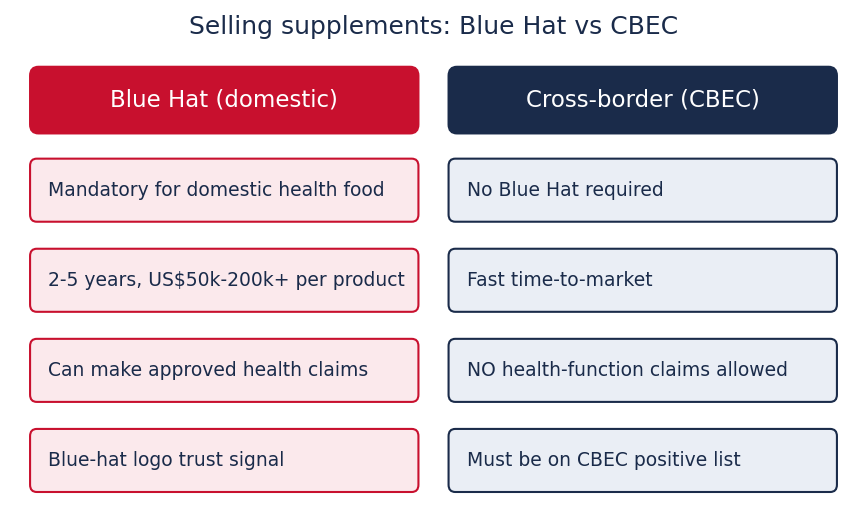
Fig. 1: Selling supplements — Blue Hat vs CBEC
The claims rule you cannot break
The trade-off is strict: CBEC supplements without Blue Hat may not make health-function claims. You cannot state the product "boosts immunity," "improves sleep," or link it to any health outcome. Marketing must focus on ingredients, origin, quality and usage scenarios — not benefits — and the category must appear on the CBEC positive list.
No health-function or disease claims.
Stay on the CBEC positive list.
Chinese labelling and documentation required.
Focus content on ingredients, origin, quality.
A compliant go-to-market
Confirm eligibility on the positive list, open a Tmall Global (or Douyin/RED) store, localize compliant listings, and build demand with RED/Douyin content that respects the claims rules. Note GACC Order 280 (effective June 2026) reshapes overseas manufacturer rules but does not directly change cross-border dietary supplements.
Compliant content tips
Because CBEC supplements can make no health-function claims, build content around ingredients, sourcing, certifications, quality and usage scenarios. Let credible KOC/KOL reviews convey experience without crossing into prohibited claims, and keep listings and ads consistent with the rules.
Talk ingredients, origin, quality
No health-function or disease claims
Use KOC/KOL reviews for experience
Keep listings and ads compliant
Bottom line
Health supplements are a major China opportunity, and cross-border e-commerce is the practical entry: it bypasses the multi-year, six-figure Blue Hat process. The catch is strict — no health-function claims, positive-list only — so build a compliant store and ingredient-led content, and treat Blue Hat as a later step for domestic scale.
FAQ
Do we need Blue Hat to sell supplements in China?
Not via cross-border — CBEC bypasses Blue Hat. You'd need it for domestic general-trade sales.
Can we say our supplement boosts immunity?
No — CBEC supplements without Blue Hat cannot make any health-function claims.
How do we market without claims?
Focus on ingredients, origin, quality and usage scenarios, with compliant RED/Douyin content.
Want to launch supplements in China compliantly? shopfever handles cross-border setup, positive-list checks and compliant content. Talk to us. |
What you can and can’t say
The claims rule is the single most important compliance point for cross-border supplements. Without Blue Hat, you cannot state or imply any health function — no “boosts immunity,” “improves sleep,” or links to any health outcome. What you can do is describe ingredients, sourcing, certifications, country of origin, quality and usage scenarios, and let authentic KOC/KOL reviews convey real-world experience without crossing into prohibited claims. Keep listings, ads and creator briefs aligned to the same rules to avoid throttling or takedowns.
No health-function or disease claims (CBEC)
Do describe ingredients, origin, quality, usage
Use KOC/KOL reviews for experience, not claims
Align listings, ads and creator briefs
Cross-border pilot zones and the positive list
Cross-border supplements must fall within the CBEC positive list and are typically fulfilled through bonded warehouses in designated cross-border pilot zones. Confirm your specific product’s eligibility before committing, since the list and requirements are periodically updated. Note that GACC Order 248/249 and the newer Order 280 reshape overseas-manufacturer registration for general-trade food, but do not directly change cross-border dietary supplements — still, verify the current position with a compliance specialist before launch.
Confirm the product is on the CBEC positive list
Fulfil via bonded warehouse in a pilot zone
Watch for periodic rule updates
Verify current GACC positions with a specialist — note GACC Decree 280 (issued 14 Oct 2025) takes effect 1 June 2026, replacing Decree 248 for overseas food-facility registration.
A channel and content plan for health supplements
Winning in health supplements is as much about content as compliance. Build a base of authentic KOC reviews to create searchable word-of-mouth, layer mid-tier KOLs for reach and topics, and use search and feed ads to capture high-intent shoppers. Keep every touchpoint claims-compliant — describe ingredients, origin and quality, never health outcomes. Connect all of it to a storefront so discovery flows into purchase within one ecosystem.
KOC seeding for authentic, searchable reviews
Mid-tier KOLs for reach and momentum
Search/feed ads to capture intent
A storefront to convert discovery into sales
Metrics that matter and how to scale
Judge performance with layered metrics rather than vanity numbers: reach and engagement for content, search lift and saves for consideration, and conversion, repeat rate and return rate for commercial outcomes. Start focused on one or two hero products, prove the economics against your category margins, then widen the range and add markets. Keep listings, ads and creator briefs compliant throughout, and maintain fast Chinese-language service to protect ratings — which directly affect how much traffic your store receives.
Working with a one-stop partner
Selling into China touches storefront, logistics, marketing, payments and service at once, and each requires Mandarin-speaking operations and platform expertise. Rather than coordinating a patchwork of vendors, most global brands work with a single cross-border partner that can join the pillars together, run day-to-day operations during Chinese business hours, and localize content and service properly. That turns a complex, multi-part project into one accountable relationship — freeing the brand to focus on product and positioning while demand, conversion and retention are managed end-to-end across China and, where relevant, wider Asian markets.


Comments